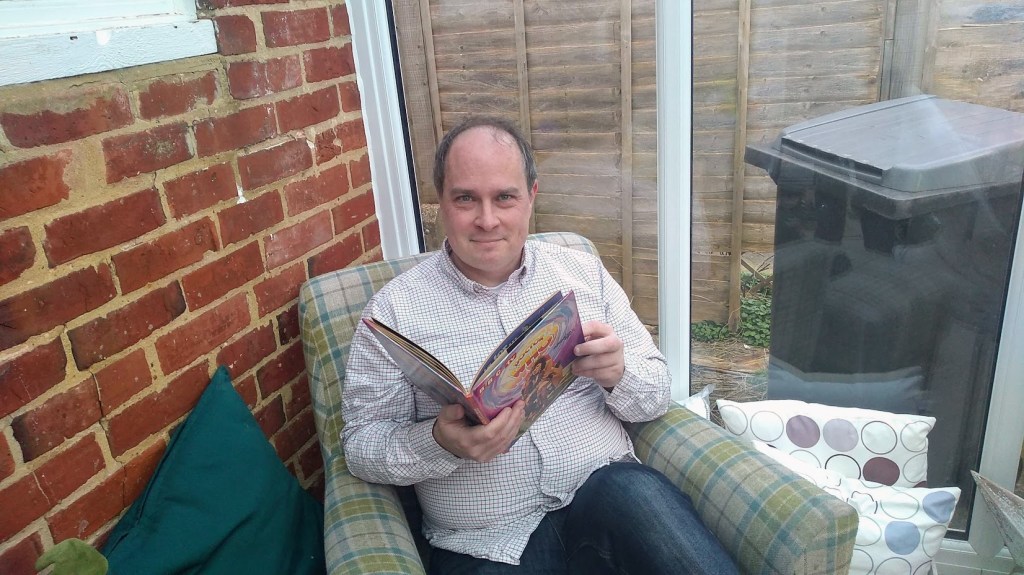
Earlier this year, Alex Hewitt was able to speak to writer Jonathan Morris about his extensive work for Big Finish, including A Genius for War, his episode from the Doctor Who: Once and Future series. Who Review can now present this exclusive interview in full.
Hello! Thanks for giving us your time. Let’s kick things off with the beginnings of your contribution to Once and Future – was your episode one of the earlier ones or a more recent addition?
I think it was one of the last ones. This project had been going on for about three or four years without me being involved. Occasionally, I’ve been to recordings of my own stories and noticed scripts for these other stories lying in the corner and them doing little extra scenes as pick-ups at the end of mine, so I was sitting there thinking ‘this is interesting’, but then getting quite grumpy that they hadn’t asked me to do anything! I’ve been around doing these for twenty years, so I always get a bit grumpy if I’m not invited to a party!
But A Genius for War was one of the last ones to be written and recorded – when I wrote it, the ones before it had already been written and the one after it had already been written, so it was slotting into existing stuff.
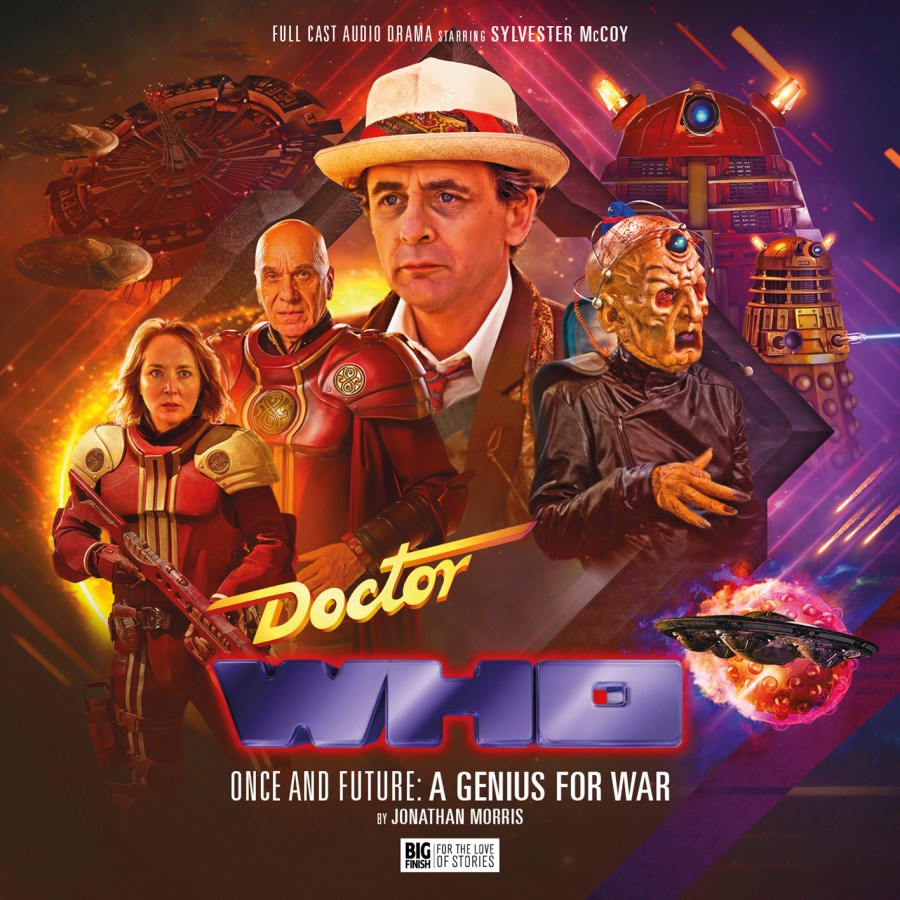
You’ve written for the Seventh Doctor versus the Daleks before. How different was it writing for this ‘degenerated’ Doctor that is in reality from a later period in his timeline?
It’s slightly complicated… what you’re doing here is going: this is any Doctor – the quintessential Doctor – but speaking with the voice and character of the Seventh. So, it was very much written for Sylvester McCoy even though it isn’t strictly for his Doctor.
But it is sort of within his character – his idioms and the way he approaches the problem is ‘the Seventh Doctor’. He keeps his cards very close to his chest and is careful about whether he lets other people into his plans, which is actually quite close to Davros. This is the point to the story, they find themselves both as agents of opposing powers in the Time War.
The other thing to bear in mind is that this is a celebration story – it’s the 60th anniversary, so you want to have little bits to make people go ‘oh that’s cool’! There have to be some punch-the-air moments, even some smaller tap-the-air moments, and some kisses to the past.
The other thing that’s odd with this is that sometimes when you write a Seventh Doctor story you want to imagine it’s 1987 and you’ve switched on the TV and it’s recreating that 7.35pm-just-after-Wogan feeling. But this time, it might be the Seventh Doctor, and Davros, but it’s also got the General in it. This is current Doctor Who as well. I was sitting there thinking about what Russell [T Davies], Steven Moffat, and Chris Chibnall would do – and what I would do! It becomes something of its own, of all sixty years rather than just recreating the 1980s.
It’s like the time scoop is bringing things from the past to now, rather than taking us to them.
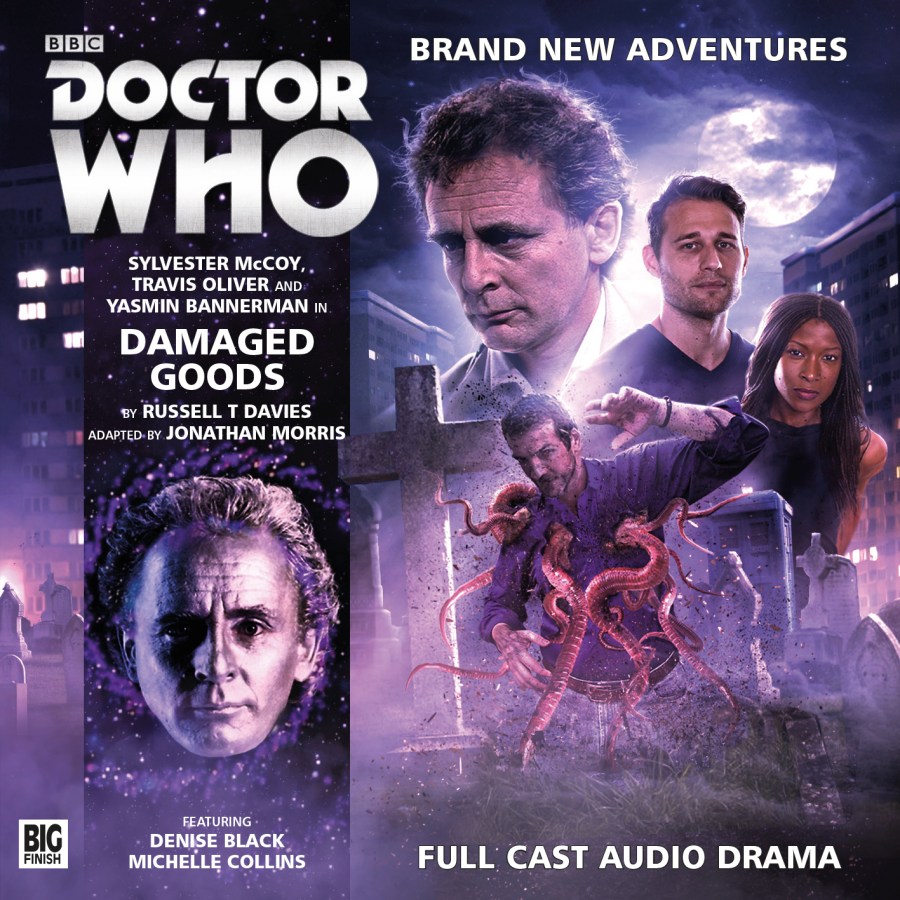
Speaking of Russell – you adapted his novel Damaged Goods into its audio version for Big Finish’s Novel Adaptations. What was your process for adapting a novel into an audio drama?
Damaged Goods was a lovely thing to do. I’m not quite sure why I was asked. I suspect it came from Russell himself – I know him anyway as I’ve emailed him questions for articles over the years. I’ve met him about four times and every time I do, he goes ‘I don’t know you’ and I think ‘yes you do!’… he must meet a lot of people.
I was delighted to be brought on to do it. In fairness, I wasn’t a huge fan of the book as it’s quite outside normal Doctor Who. I’m quite a traditionalist, but as a novel it’s a really good book. Certainly in adaptaing it, I wanted to keep all the things that were cool about it and that other people would want to keep in it.
Also, it had to not just be an audio, but an audio for 2015 when the rules for Doctor Who had changed. When Russell was writing it, he was writing it for: probably men, possibly gay men, and men in their 20s. That was a completely different audience to now, when someone who’s ten years old might listen to that audio, so you have to change it to make it accessible. Also, Doctor Who has changed since then – it’s a modern TV show, and that was something I had to bear in mind as well.
The Time War itself was created by Russell, and given you’d written an RTD Seventh Doctor audio, did that help in any way when it came to writing A Genius for War?
I don’t know. I think my mind went on a different track, actually, because the brief was Davros and the General. Davros had come back in The Witch’s Familiar, and Steven Moffat had actually shown the Time War in The Day of the Doctor, so I was much more thinking along those lines. Particularly, exploring Davros’s character and motivation in The Witch’s Familiar made me think, that’s where we see him end up, so could I tell one of the stories leading up to that point?
Matt Fitton had written an Eighth Doctor: Time War story which ended with Davros being sent to prison on a moon, so I read that story to get myself up to speed. I then had the hook of ‘Davros wants to be rescued by the Doctor because Davros wants to help the Time Lords defeat the Daleks’. It goes all the way back to Genesis of the Daleks, when Davros helps the Thals destroy the Kaled dome. Actually, in a time war, Davros would change sides – but he’d also be up to something!
The other thing was something that happened during the Second World War. One of the German High Command – I think it was Hess – flew to Scotland, just sort of turned up, and said he wanted amnesty from the Nazis, and he was going to help the Allies. He got locked in the Tower of London, and I was thinking ‘what if Davros did the same kind of trick?’, coming to the Time Lords and wanting amnesty. That’s where it came from.
There are all sorts of nods to the past in A Genius for War – references to The Trial of a Time Lord, and Genesis of the Daleks. But when I was researching the Moon of Falkus, I typed it into the TARDIS Wiki, and in the Doctor Who and the Daleks Omnibus from 1976 there’s a whole page about this moon. I’m lucky enough to have a copy of that book, and it’s by Terry Nation, so I thought I’d pull all this stuff in and use it in the story, even though most people won’t have a clue why I’m using this! It’s this idea that Davros is using the moon as a Dalek seed bank, and I picked up on that aspect of it.
Going back in time a little, how did you first get involved with writing for Doctor Who?
It was a long time ago! We’re going back to 1998. I’d written a few little things in fanzines and charity books, and during most of the 1990s I was taking a hiaitus from Doctor Who as it wasn’t on television. But then I got back into it again through the books – the New Adventures and the BBC Books. Reading them, I was inspired both by some really, really good ones that made me go ‘this is fantastic, I wish I could do something like this’ and some terrible ones! I’d read them and think ‘if they’ll publish this, they’ll publish anything – or at least, they must be quite keen to find people who can do a better book’.
The combination of the two meant I sent in a storyline and a sample chapter for what became Festival of Death, my first book. When I sent it in – and I only found this out recently – Justin Richards at the BBC read my synopsis and my chapter and thought ‘this guy’s actually good,’ so he forwarded it to Gary Russell at Big Finish who thought it was fantastic (his words, not mine!) and got in touch to ask me to do a Big Finish story at the same time. He wanted me to do a Big Finish before the book came out so he could pretend he discovered me!
I already knew Gary before that, because I ran the Erasure fan club and Gary was one of the members! But we didn’t know each other socially until I was working for Big Finish – I always emphasise this. I didn’t get anywhere by being friends with people!
What was your first Big Finish and how was that experience?
The first one that I wrote was Bloodtide which came out in 2001. Silurians and Charles Darwin. They’d only been going for about two years by that point. One of the interesting things about that period was that the timeline of making stuff was really long, so it had been recorded about a year before it came out, and I’d written it about a year before then!
So, by the time it came out it was quite old from my point-of-view, and I’d already started the next one. But it was very exciting. I remember being at the recording, with Colin [Baker], and just hearing it come to life was fantastic. The actors were making it better, which is just what you want. They were lifting it, and the voices were perfect. Colin had prepared and done his homework, so it was a really good one to start with.

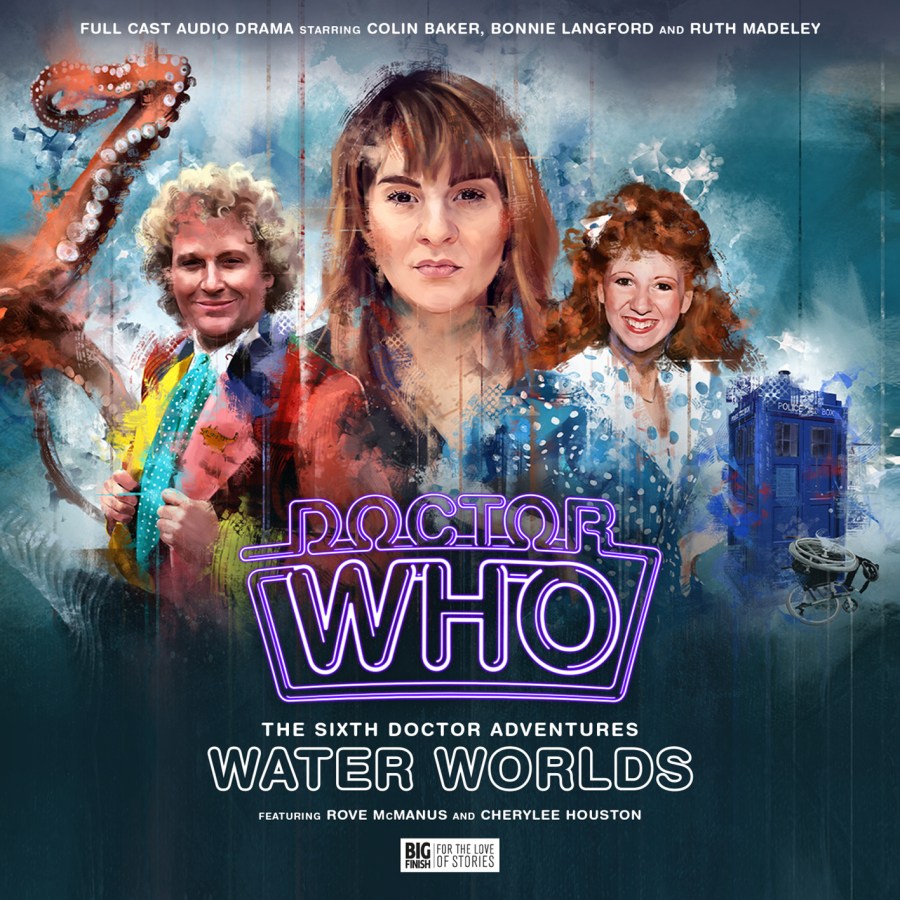
You’ve also written a couple of the new Sixth Doctor Adventures with Mel and Hebe – how did that come about?
The first of those I did was called Maelstrom, which was a story idea I’ve had for about fifteen years! When I was doing the Doctor Who Magazine comic strip back in 2009, it was one of the ideas I had then. A ship of lost souls where people have their brains in a computer and they’re downloaded into bodies. The brief I got was ‘a story set on an ocean world’, and I had this story about people living in a boat, so that fit.
It was lovely to write a character like Hebe because my brother was a wheelchair user so I have an understanding of the issues there. The problem is never the disability, the problem is the world which has been designed for people who don’t have the disability. It’s the bad design that’s the problem.
A few months after that, I was brought in to do another one because another story had fallen through or perhaps not worked out – which happens. It’s happened to a few of my stories in the past! I volunteered to help out because I had a couple of weeks free to write a story fairly quickly.
Have you found that the process has changed in the years between your first story and the stories you’re writing now?
There are certain things I’ve learnt over twenty years. I’m not saying I’ve improved, but I’ve become more efficient. Twenty years ago, I’d be very, very slow and meticulous writing stuff and do lots and lots of drafts. Now I can get to that point much quicker.
Each episode should be about 4,500 words long. Now, I’ve somehow got the skill where I finish a draft of an episode and I look at the word count and it says ‘4,520’. Having spent years of writing stuff where I’m normally trying to get it down to length, I’ve now got to the point where when I’m writing a synopsis or a scene breakdown or actually writing it, I’ve got a sense of how long it needs to be, how to get in and out of scenes, and how to establish information. But it’s still an ongoing process.
One of the things that makes it interesting is that you write a script and at the end you know how to write that story, now that you’ve written it. That knowledge is of no use to me whatsoever when I write the next one. I have to start from scratch every time, when there are new characters and monsters and settings.
Finally, do you have any teases for other stories you’ve got coming out?
I’ve written a story for Classic Doctors, New Monsters with Harmony Shoal from The Return of Doctor Mysterio where they put their own brains inside people’s bodies. It’s those monsters in an early Tom Baker idiom, which is why it’s called Invasion of the Body Stealers. It’s a Hammer Horror take on these monsters. What I didn’t know when I recorded it is that it was the first one that Sadie [Miller] had done as Sarah Jane outside of The Lost Stories!
That’s from a couple of years ago – quite a lot of the Tom Baker stuff has been recorded and banked for years. Doctor Who and the Ark was quite recent though, that was only last year because Simon Guerrier, who produced it, was quite keen on getting it out without there having been a big gap after Return of the Cybermen. I think I only had about a week to adapt it! But adapting it is more a case of going through it and changing the scene directions into stuff that’s in the dialogue, and resisting the urge to improve it or add my own voice.
Sometimes when I’m script-editing it’s quicker to rewrite the whole thing and send it back to the writer and say ‘now you change it back’, rather than to give notes. Notes take time, it’s a lot easier to show them how I think the scene should be, even if that doesn’t have to be the end result. When I’ve script-edited stuff that’s generally how it’s been done.
So yeah, The Ark was done fairly recently. And I’m writing more. While Tom is with us, we’ll keep writing and recording. I can say that I’ve done some more because that’s going to be of no surprise to anyone. They’re sort of like time capsules, they get buried for six or seven years. The Body Stealers is from quite a long time ago, and there are ones that I wrote that were recorded before that that have not even been announced yet. There’s a worry that someone else or the TV show will do my cool idea before me, and it looks like I’ve stolen their idea!

Big Finish are generally quite efficient in making sure that everything that’s been paid for gets made and released in some form eventually, but sometimes it may take a while. I wrote a John Hurt story that eventually got made with Jonathon Carley as the War Doctor. One of them became a Paul McGann story – that was quite funny because David Richardson asked me how it felt to have written for the Time War 2 boxset, and I was going ‘I don’t think I have!’ and David told me, ‘no, you have’, and sometimes that’s how you find out!
I’ve had gaps of not working for Big Finish for about three or four years, and no-one’s noticed because I’ve still had stuff coming out. And there’s points like now where I’m writing a lot of stuff but nothing’s coming out! There was a point in about 2012 when I had two audios coming out, a comic strip, and a book coming out all within the same two weeks. This is why people have pseudonyms, to try and disguise how much they’ve been doing.
But generally the amount of work is consistent at the moment. I’m really happy to be doing so much.
Many thanks to Jonathan for speaking to us. His many stories for Big Finish, including his contribution to the Once and Future series, are available at the following link: https://www.bigfinish.com/contributors/v/Jonathan-Morris-176
 Who Review
Leave a comment