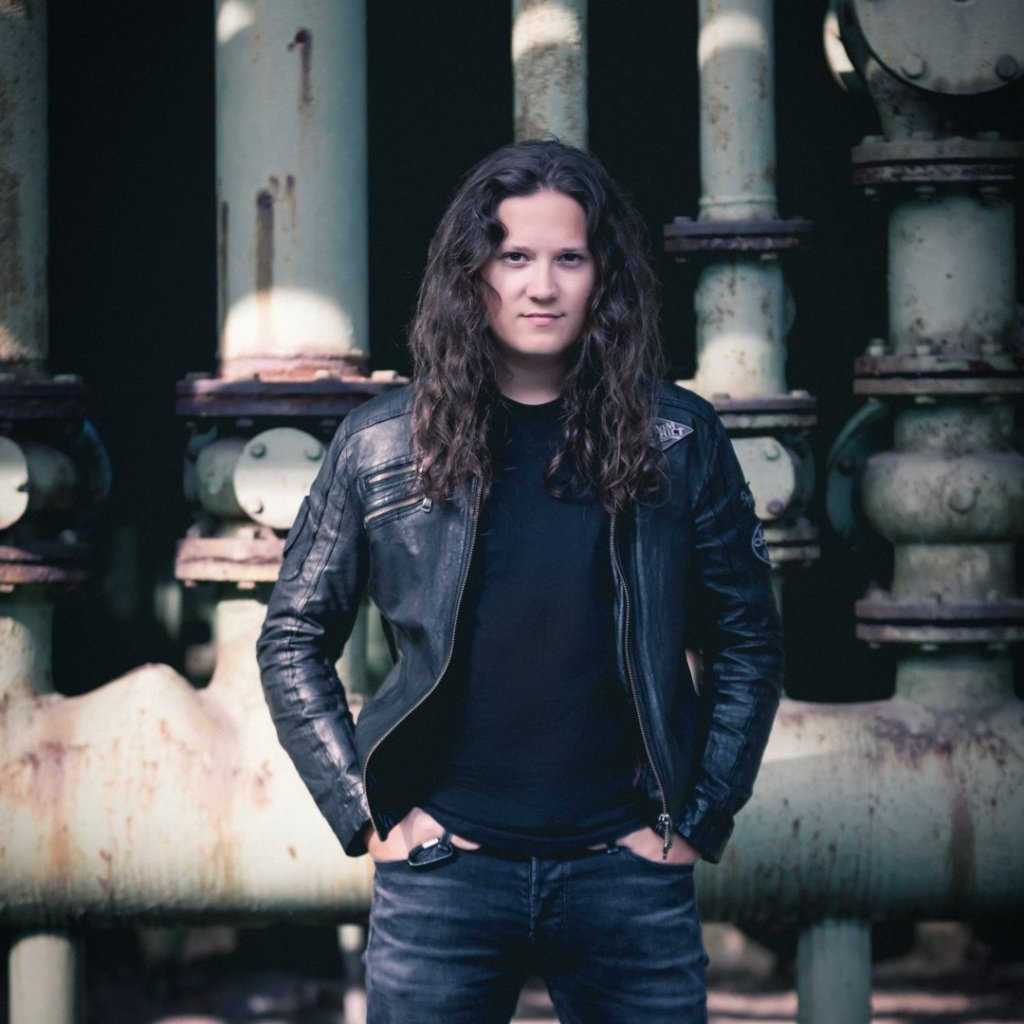
Following his recent work on The Eleventh Doctor Chronicles, Borna Matosic spoke to Alex Hewitt about Doctor Who, music, and his career as a whole. This exclusive interview is presented here in full.
Let’s kick off with a very broad question – how did you first get into composing music?
I started with music pretty late. I was never much interested in music as a kid. I didn’t really listen to much music, because most of what you could listen to in the ’90s on the radio or on MTV was pop music, and that was never really my thing. What I discovered is that I did like music from films at the time. I loved soundtrack music, but never really pop.
Then I discovered rock music and heavy metal, which really started my active listening journey with bands like Iron Maiden. They inspired me to pick up the electric guitar. My first instinct was to buy an electric guitar and learn every Iron Maiden song there is. What actually happened was, the day I got the guitar I plugged it into the amp and immediately started composing my own stuff. It always came easy to me. It was only years later that I realised not everyone is born with the musical ear to hear a melody and play it!
What sort of things were you composing?
I started with rock/metal songs. But I always had this love for soundtracks – including video game music. I had my mother record some of the Super Nintendo stuff we had on tape. The Super Mario theme, and Zelda and stuff like that. That was the stuff that I found inspiring. Years later I started to analyse the old video game music to try to figure out why these particular tracks had these effects on me. I started to see similarities – similar musical tricks they used to evoke certain feelings.
And then I just started using the same tricks for the music I was composing, doing pub gigs with a band I was in. I was the songwriter and so I had to start learning how to notate it all for the rest of the band. I was starting to use notation software so the rest of my band could work out what I was trying to get out of them.
Slowly but surely I started to learn how all the rhythms work, and how to translate everything I had in my head into actual notation – that’s also when I started to experiment with orchestral music. In the notation programme it’s the same thing. It doesn’t matter if it’s an electric bass or a double bass. I started to experiment in that field and then in 2014 I decided to take part in a short film festival.
How did you get involved with that, and what was the experience of working on a film like?
I offered my music services to the teams that were participating and it was an interesting approach. It was a 48-hour challenge. The festival picks a title and genre from a random ballot for each team. They told me, “we’re going to have this scene, then this scene, then some cavemen show up…” and I was just going to sit in my room and compose music for the scenes I had in my mind.
For some reason most of it worked perfectly! It fit to the second. I made some little adjustments and then we won the festival! I got my first soundtrack award, and so I thought it looked like I was doing something right. That was how I started to compose in that area while I was still doing regular songs with my band.
From there how did you become involved with Doctor Who-related music?
2018 was the first time I did something related to Doctor Who. I did a YouTube cover called the Regeneration Medley. It came out shortly after The Woman Who Fell to Earth, which gave us our first tease of the Thirteenth Doctor’s theme. I thought it was a good opportunity to practise some of the scoring, trying to recreate Segun Akinola’s music on a budget.
I got pretty close to the original piece, but to differentiate it rather than making it a perfect copy I did some other stuff. I played a guitar over it, because that’s my instrument. The thing with using samples is they never sound quite like the real thing, so it’s always a good idea to layer something real on top of the sampled instruments to get some humanity in there.
The biggest twist of this cover was that midway through it goes off into Murray Gold’s Doctor theme and includes elements of I Am the Doctor and A Good Man? and had them all overlap and culminate in the Thirteenth Doctor’s theme.
That was my first YouTube video that really took off – maybe because Doctor Who was doing really well at the time. It had 30,000 views in the first six days! My goal had been to get to 10,000 views at some point, so it really took off. In just a few weeks it had reached 100,000 views, which is what made me decide to do more Doctor Who covers for YouTube.
For the video, you put yourself in the TARDIS – how familiar were you with this type of video production?
I knew that it would make it stand out from the masses of other YouTube videos. I learned green screen and all the other video production techniques just for that cover. I had a little bit of experience in video production before, but nothing with green screen. When I look at it now it almost looks perfect, I don’t know how I did it!
After that it was The Shepherd’s Boy. For that one, I wanted to make an even better video. It was two or three months just to figure out how to rebuild those sets inside my computer to make them look 3D. What I did was take a screenshot with Capaldi in it, brush him out, recreate the part where he was standing, and then simulate a 3D environment by bringing in several layers.
I cut out the set into different layers and had the programme create a 3D impression. When I look at the video now I’m really happy with the results. I had comments asking, “how did you go to the sets?” and that was when I knew I’d succeeded.
Then it was Doomsday, which I actually went to Bad Wolf Bay for! This was a direct result of the months of post-production I’d spent on The Shepherd’s Boy – I wanted to do something on location as I knew it would be less post-production.
In 2020, the world went into lockdown – how did you become involved with Emily Cook’s ‘tweetalongs’?
While she was doing the tweetalongs, someone had commented on one of my YouTube videos suggesting I do The Long Song. And I was going, “how can I do that without a choir?” but then I realised we could do a singalong with the tweetalongs. I immediately went to my fiancée and she was like, “great idea, but how are you going to do that?” which was when I had the idea of going to Emily.
She thought it was a great idea and trusted me to pull it off. The whole thing was crazy ambitious. When I think about the sound we got out of our virtual fan choir, it was amazing. I was betting on the effect you have in stadiums – maybe not everyone’s a perfect singer, but everyone equalises each other and the melody becomes clear even if 95% of them are drunk!
Luckily, these people weren’t drunk which gave us an advantage. When I clicked the play button for the first time and had them all synchronised I was blown away. It was so much better than I’d hoped. We did two more – the most complicated, Vale Decem, was saved till last but it had always been planned to do a trilogy.
Was it through these that you became involved with Big Finish?
Yes – Emily started working with Big Finish shortly after that. We’d always said we’d do something else in future. Not singalongs, but something else. I was really happy when she asked me to do the music for UNIT: Brave New World, because she’d said the plan for the series was to do a kind of X-Files combined with Doctor Who in the ’90s. At the time she said this, I was finishing an X-Files rewatch, so I was in that ’90s mindset and on board immediately.
I was happy to get the chance to show that I’m not just able to do covers. A lot of people go to my YouTube channel because they want to listen to my Doctor Who covers, but it was really fun – and an honour – to add my own music to the Doctor Who universe.
How did you find creating a brand new theme tune for the series?
I had seven different piano demos that I sent to Emily. I secretly had a favourite, but I didn’t tell Emily. Guess which one she picked? My favourite! We both agreed on it, so it was obvious that it was the one. The first version actually didn’t have electric guitar, but Emily requested that I added it.
I really fell in love with those characters, and the drama of that series. I hope there’s more!
From there, how did you get involved with The Eleventh Doctor Chronicles?
Alfie [Shaw] had written an episode in the first boxset, and he sent me an email shortly after I finished Brave New World stuff where he asked if I wanted to work on The Eleventh Doctor Chronicles. Of course, you don’t say no to that! At that moment it was clear to me that I’d have a chance to write a theme for the Eleventh Doctor. I immediately had this theme running so I composed it on my piano in about five minutes.
How did you find ranging from low-key stories such as Broken Hearts to Dalek epics like the final boxset?
What comes easy to me is melody. I can write twenty pretty melodies a day, but when you’re working on audio drama most of it is dialogue driven as you don’t have visuals. Composing for dialogue is super complicated. It’s the most difficult discipline in film scoring – you could write whole books about this topic! You need to stay under the dialogue, sometimes you don’t need any music, but you have to pay attention to where the music enters, exits, and whether there’s something in the dialogue that changes the story.
When you try to write under dialogue you usually don’t want too much melody. That’s the challenge for me. But I can write soft pieces. Like for Broken Hearts, when you have the robots all alone on the planet – you hear Lionel with his little robot wheel, all alone on that deserted planet searching for life. You can have melody there, and it works beautifully. It wasn’t too hard to do the softer stuff.
Is it difficult to score for Daleks, making sure the music doesn’t clash with their voices?
That’s a great question – the Daleks are super loud and obnoxious. The challenge is, how do you not score too big but still have them feel dangerous? I have two different Dalek themes in the set. One’s when they’re mainly in control and not doing much. When they’re on the Dalek ship and scheming, it’s an eerie-sounding atmosphere. Long notes that don’t interfere too much with the sound effects.
As well as the voices, because it’s audio drama, you have to make sure that the music doesn’t trample the sound effects. You need this balance where the music is there but under the rest. So, for the scheming parts it’s soft and atmospheric. But when the Daleks are in ‘action mode’ I wrote a Dalek theme that progresses through the episodes and gets bigger.
For more on Borna’s experience composing Victory of the Doctor, check out our preview here.
Many thanks to Borna for his time. You can find Borna on X/Twitter @BornaMatosic and online at https://bornamatosic.com. Additionally, his Big Finish page can be found here.
 Who Review
Leave a comment