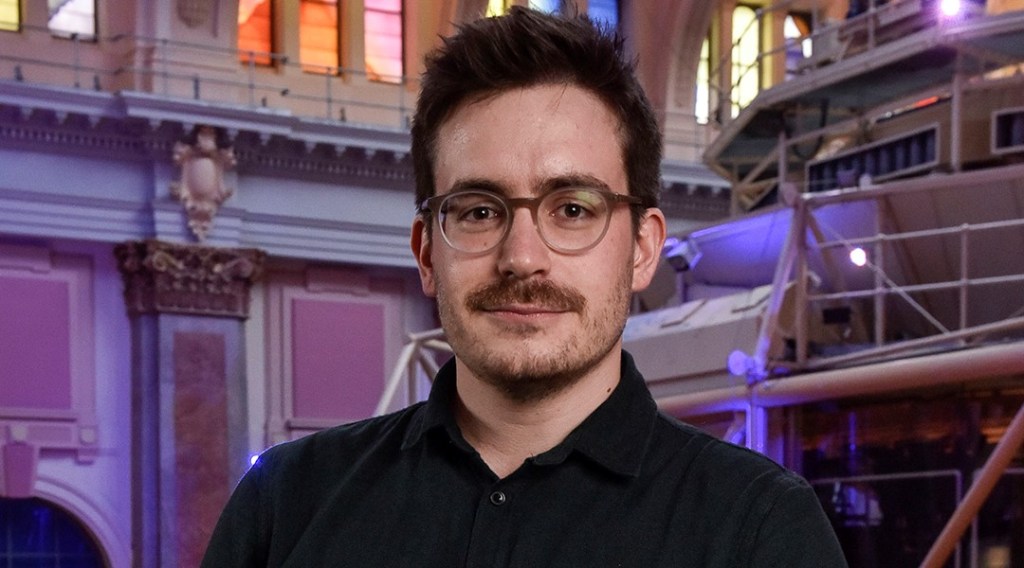
Tim Foley is one of Big Finish‘s most prolific writers in recent years. In the first part of this exclusive interview, he spoke to Alex Hewitt about his beginnings at Big Finish, some of his recent releases, as well as briefly previewing Dark Gallifrey: Morbius.
Hi Tim! Thanks for chatting to us. To kick things off, how did you first get involved with Big Finish?
I was commissioned at the same time for The Empty Hand and my Gallfrey: Time War [2018’s Soldier Obscura]. And that was basically because I had done some theatre stuff and I was feeling a bit cheeky and I just DM’ed Scott Handcock. He was taking pitches at the time for something that didn’t come to anything, but about six months later he was like, “do you like Gallifrey and/or do you like Torchwood?”
At the time, I loved Gallifrey – it was one of my favourite series. But I didn’t really care about Torchwood! But I said yes, and I ended up writing two at once, which was awesome! I’d never actually heard the Torchwood audios before I wrote for it because a lot of my Big Finish listening was when I was in my teens. After university and in my early 20s I couldn’t really afford any of the new releases, and Torchwood was a new release, so I hadn’t heard any and didn’t know its full potential.
What did you work on after those two?
I forget when things get released. After I handed in The Empty Hand, it went down well with Scott and [James] Goss, and a writer had just dropped out of doing the opening story of the next boxset. They were like, “is there any way you can write a script in two or three weeks?” and I was like, “yes! I am eager! I am keen!” so I got my foot under the Torchwood table and got to do some great stories with those guys.
Moving to your recent work, outside the worlds of Doctor Who, you worked on Dark Season last year – how did you find that?
This was Scott Handcock, so I was like, “absolutely, yes”. I’m a bit young for Dark Season so I sought it out and it’s great. It’s really funny and also hugely frustrating that when Russell T Davies was my age he was writing this funny, intelligent children’s dramas. I was working on that, and Russell came on board, and it was great. It’s fun to do original stuff with new characters.
You also did a 2-hour feature-length Omega Factor story – what is it like writing in this form?
That was lovely. I told David Richardson a couple of years ago that I really wanted to do some stories longer than an hour, and he’s been really good at finding me opportunities to do big things. He’s given me 2-parts, he’s given me 3-parters, he’s given me 4-parters. He also knows I like to work on different franchises to stretch myself. I did Blake’s 7: The Clone Masters, and then because Omega Factor can be a bit more adult it was the stuff I enjoyed doing with Torchwood.
When I started doing Doctor Who, I struggled a bit with the tone for pitching. I had to temper what I could talk about. But I’ve found the parameters for that again – within whatever boundaries you’re set, you’re always pushing within that.
Speaking of Doctor Who, The Great Cyber-War and The Empty Man were both stories by you for the new Eighth Doctor Adventures with Audacity. What was it like writing the story that re-introduced Charley at the end?
I didn’t actually know about that until my second outline. I knew it was something they intended all along, but I didn’t realise it would be my release that ripped the mask off until we were a few stages into it. My episode in In the Bleak Midwinter was because when I found out about Charley I was like, “I really want to write for Charley”. So, I begged Matt [Fitton] if I could do a proper episode with her rather than just a, “hello!” at the end. The Eighth Doctor and Charley was the first series arc I was invested in – I watched so much classic Doctor Who as a kid, but that doesn’t necessarily have series arcs. But the Eighth Doctor and Charley… love it.
The Empty Hand was a bit of a love letter to audio writing in general. The character was based on Algernon Blackwood, who used to write Christmas ghost stories and was also then one of the first BBC presenters, who would tell ghost stories on radio. I think it’s a lovely concept that even at the beginning of radio there was someone sitting close to a mic telling ghost stories.
Last year’s War Master: Rogue Encounters boxset opens with you episode Runtime – what were the challenges like of writing something like this?
I love Handcock – this was still one of his boxsets – and he just set me a challenge that was, “can we do an episode that’s like 1917 where it’s all one shot?” and I thought I’d give it a go. So it’s a 60-minute, real time episode where the Master has an hour to stop something.
Earlier in 2023, a man called Ellery Quest wrote All of Time and Space – what do you reckon he would say if he were asked about it?
It came about very quickly and accidentally. I gave [Alfie Shaw] something in less than a week. I do like a swiftie. We were talking about Dissected for ages, and then Goss and Scott were like, “we have [Freema Agyeman] in next week, can you write everything that we’ve been talking about?” That was over a weekend.
You also occasionally script-edit – what’s that process like?
I only really script-edit James Goss, and [John] Dorney, and script editors who know what they’re doing and just need a sounding board. So I wouldn’t call myself a script editor per se. I don’t do a lot of it, but it’s fun when I do it.
Before we move onto some of your upcoming work, Torchwood: Among Us was one of Big Finish’s best-received series last year – how did you find it crafting this new era for Torchwood?
We didn’t think it was going to happen at some points. Even something as late as Heistland – this is like, the third version of it. It was never meant to just be me, Goss, and Ash [Darby] doing the whole thing, but it was lovely that it was because it meant we could just put our heads together. And of course there’s Una McCormack’s episode too which is great. That comes from a period pre-pandemic.
My Eve [Myles] one for that [Misty Eyes] we did at the exact same time as Dissected. It was lovely that there was the opportunity to think of different versions of what this series was going to be. There was a point when I had Misty Eyes, most of Cuckoo, and most of At Her Majesty’s Pleasure recorded and I was like, “is there a world where that comes out as a little trilogy and we focus on making the new series a nine-part?”
Goss was really open to lots of different iterations like that. It was nice, because I’m not a producer, and it’s normally the producer who shapes the series, but it was nice having some insights and influence into what the series should look like.
Have you been pleased by the fan reaction to the series?
I don’t know. I have to disengage sometimes from what the fans are saying. There’s different kinds of writers, and I am very self-critical. I struggle to listen to my own stuff, and I will struggle to engage with the stuff after the fact, because six months down the line I’m like, “oh, that’s how I should have written this script”. Because you’re in a state of constantly writing, and coming up with new ideas, you can always think of how to fix things after the fact.
But I’ve seen nice things! I just struggle to gauge how much people listen to my stuff, how much people enjoy my stuff, but that’s all right. I don’t want to get too invested in the releases of them – I’m more interested in the process rather than the product. But yes, it seems to have gone down well.
Finally, let’s talk about some stuff you’ve got coming up. Tell me a bit about Dark Gallifrey…
I think it’s some of the best writing that I’ve done. I’m dealing with Morbius straight after the War. It’s really different. Every writer’s not only got a different Time Lord, but they’re allowed to explore different form. We’ve had creative control basically about what stories we tell and how we tell them. I’ve gone for a big, old, gothic, nautical thriller.
I fucking adore the longer stories. You get to do worldbuilding, you get to dive deeper into characters. It requires more patience from the listener at times. I tend to do a lot of set-up in part ones, which I don’t apologise for. Whenever I had the opportunity I would always push for the longer story. This especially excited me because Dark Gallifrey is the ‘villains trilogy’ from 2003 but done on a grander scale – almost operatic.
We were encouraged to explore different characters and things, so we were given options of who it could include, which is why there’s Morbius and the Fourth Doctor. It’s one of the few recording sessions of recent years I’ve listened to and bloody heck, it is juicy. Samuel West is the one person who can play Morbius. He is sublime.
Many thanks to Tim for his time. Dark Gallifrey: Morbius is available to pre-order now from bigfinish.com; Part One releases tomorrow, 3rd April. You can also find Tim on Substack. Keep an eye out for the second part of this interview, where we’ll be talking about murder mysteries and some more of Tim’s upcoming work.
 Who Review
Leave a comment