Alex Hewitt was able to speak to Sean Longmore for a massive, exclusive interview for Who Review. Presented here is Part 1 of this interview, with Part 2 to follow in the coming weeks.
How did you get started as an artist?
Ooh, that’s a question. I always say I’m a bit of a fluke, really, because I never trained properly as an artist. They wouldn’t let me take art as a GCSE at school – I was told I wasn’t good enough at it. Kind of ironic, really. It kind of came about while I was at uni as a side thing. I was always good with computers and I picked up some graphic design bits on the side while I was studying at uni.
What were you studying at uni?
I was studying media and performance, so I picked up doing graphic design freelance in theatre on the side, and luckily enough when I came to leave uni I got a job in a full-time studio for the arts in a theatre over here in Manchester, so I did really well and got really lucky there. Then, suddenly, there was a transition where my whole life became graphic design. It was very much a baptism of fire, of learning on the job, learning to be a designer. I was there for a few years and left this year to work freelance. Like I say, I do feel like a bit of a fluke – I get terrible impostor syndrome sometimes.
Did you find it challenging learning without any formal training?
Oh, absolutely. It was crazy. Like I say, I’d done some through uni and picked up bits but suddenly I was in an environment where briefs and jobs were coming in thick and fast. It would have been very, very easy to fall off the treadmill, so to speak. I was coming into a working environment that was already very busy. I was working in a ‘receiving house’ theatre, which means they have tour productions coming in and out every week. The theatre I was working in had three stages, so there was something different on every day. Suddenly I was working on shows and using assets with a very short amount of time, and you just have to pick it up and learn. So yeah, it was very difficult, and there wasn’t much mentoring in that job initially. As soon as I started, another person left, and it was a very small team.
So you were literally teaching yourself?
Pretty much. There was a while during my first year where I spent about six months on my own as a one-man design team. It was a case of suddenly using all kinds of programs – I had probably used mostly Photoshop, as any starting graphic designer does, and then I was in the depths of InDesign, Illustrator, Premiere Pro, and just adapting really quick. But I think that was the best way to do it.
Do you think having taught yourself means you’ve found easier techniques and tricks than if someone had been teaching you what to do?
Very possibly. Maybe I’m just doing everything slightly wrong! It’s just a case of exploring. It’s hard when you’re exploring and you’re working on someone else’s time. That was something I was always very conscious about. I was being paid by someone to do the job, so you just have to learn how to use everything but also be time-effective. So you’re also learning the most time- and cost-effective ways of doing things as well. And the pace was absolutely crazy. There was a point a few years into that job where we were turning round 40 to 50 projects in one week – and we were only a team of three at that point.
That must have been stressful – how did you manage that workload?
There were a lot of late nights, and there was a lot of teamwork. It was really invaluable. And something else that was really invaluable experience-wise with that job for me was that the design studio was inside a marketing team. So that really helped give me a lot of insight into how to make work marketable and knowing what to focus on – focussing on certain USPs, certain selling points, what information to highlight, and stuff like that.
Was the collaboration helpful to take the stress off?
Absolutely, and I think it’s something a lot of people forget with design and when they’re training – is that with any job, you’re working to someone else’s brief. So being able to get feedback on your work and being able to negotiate criticism – not necessarily take criticism, but have someone critique your work and then know what stuff to push back on and stuff like that – is half the job. We worked with work experience people and graduates and from what I’ve seen that was taught, a lot of technique and design history and stuff like that is taught but you’re never taught the briefing process and I think that’s really valuable to learn, and I’m grateful that I was in an environment where I could pick that up. It really helped me out, working on professional projects.
Where did you go after that initial period where you taught yourself?
I started as a junior designer, and by the time I left at the start of this year [2022] I’d worked my way up and was senior on the team. I was fortunate enough to be leading the team and then during lockdown and the pandemic suddenly I was on my own – I live by myself – so I needed something to occupy my time when I wasn’t working remotely, and I started doing various projects, bits of art. Like James Bond art, stuff that I’m sure people will have seen. It came to the point where I was getting lovely work offers and contracts where I had enough then that I was able to work freelance and pick up work for Big Finish.
What was your introduction to working for Big Finish?
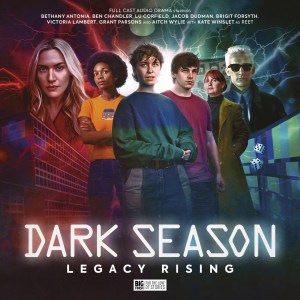
It all came about at once. I am absolutely indebted to the wonderful Lee Binding. I feel like I bother him all the time, I was always messaging him because he’s full of wisdom. I don’t have enough praise for him. He’d seen my work and we’d been chatting a bit for a few months, and then it came to one day where he sent me a message and said “how about you do some Big Finish?”, and I’m sort of my own biggest critic so I didn’t think I was ready for that but he said “no, you’ll be fine, you’ll be great”. And I didn’t know while he was telling me this that he was going to be leaving Torchwood. He then put me in touch with the equally lovely Scott Handcock, who then briefed me and I did Dark Season, and we also did my first War Master [2022’s Self-Defence]. Scott was wonderful and really patient with me – they were both very different projects to work on.
Then Torchwood came about when James Goss said that they were looking for someone to replace Lee, and I was on the list of designers and James asked if I’d like having a stab at one. I’d been listening to them for ages, I remember the first one coming out, I’ve got all the CDs, so I thought “absolutely”. I remember what a big deal it was when those first audio releases came out, so it was a bit of pressure. But I’ve always adored Torchwood and so I jumped at the chance. I started with The Red List, and that was a learning curve. Again, James Goss was very patient with me while I was trying to pick up the style of that. And then I did The Grey Mare, and then it just became a regular project, which I am incredibly grateful for.
Can you tell me about any challenges with creating Torchwood covers?
Well, with something like The Red List, for both Ace and Mr. Colchester we only really have headshot photos. With Ace they were done when she returned in Class, and the Mr. Colchester ones were taken for the announcement of Aliens Among Us, so we were working with quite old photos but it was then a case of finding bodies that looked suitable. I remember spending a long time trawling through various stock to find a suitable outfit for Ace.

I love that you picked one that went with the vibe from the Season 26 Blu-ray trailer.
Yes! Simon Holub had done an excellent cover with an older Ace for Dark Universe, but with the brief I got it was sort of “Ace on holiday”, so I was thinking “is she really going to be wearing a full-on business suit?”, and as this was my first one I was picking it apart in so much detail and really reading into it. It was also a case of thinking that this is Ace in Torchwood, not just Doctor Who. I’m very much the sort of person who listens to Big Finish thinking about how it would look if it had been made on tv, so I was thinking about how a costume designer would have dressed Ace, as well as keeping in mind that this was Ace in Torchwood, not just Sophie Aldred. And that’s where the earring came from. Originally I was going to put Batman earrings on her, as she wore in the ‘80s, but I realised that that might cause some licensing difficulties, but then I thought I could use the Ace logo! So that cover was great. It went through a couple of different stages, and a couple of different designs. As I say, James Goss was lovely and patient with me on those early releases, because it was hard adapting to Lee’s style originally.
It took a lot of getting used to. James explained it to me brilliantly – the covers are like snapshots. With a lot of Big Finish covers, you’re packing so much in that it becomes a collage or a sweeping epic with characters of various sizes, or something like that. But with Torchwood, it’s really a snapshot of the story. It’s got to look pretty fantastic, it’s got to look sexy – because it’s Torchwood – it’s got to look hyperreal, and just really look like a polished snapshot of the story. With Cadoc Point, James sent me a full breakdown of what was going to happen in the script, so I put all these different elements of the story into the cover, but James came back and said “it’s great, but it’s not the Torchwood range, it’s too much”. And then when I pulled it back it was spot-on. And that’s when it stuck with me that this was the Torchwood style. There’s a lighting source in the back, a character looking great in the front, and a sprinkling of setting.
Do you get briefed on the entire synopsis of the story and construct a cover from there for all the ranges you work on?
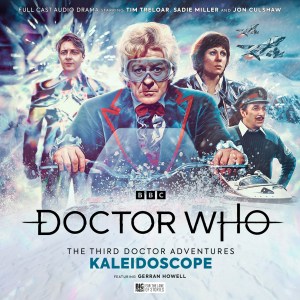
It completely depends on the project and the producer. The wonderful thing about Big Finish is that everyone’s looking after their own different projects, and there’s a lot of creative space for producers and writers and such to work in. I’ve worked with James, Scott, and Heather Challands and Nick Briggs on the Third Doctor Adventures, and they’re all very different types of producer. Working on Kaleidoscope was the first time I had a drawing – we were in a pitch meeting on Zoom and we’d been talking about the cover. I’d already read the script for that one, and Nick then came out and said “I already know what I want it to look like, I’ve done a drawing”. Fortunately, I agreed and thought we had to have Jon Pertwee on the snowmobile. It was pretty similar to what I had in mind anyway. We were really in sync with that one, which was great.
Torchwood briefs are very, very different. James’s briefs tend to be concise – in a good way. I don’t see the scripts or really get much of a sense of story beforehand, which is very deliberate and I wouldn’t want it any other way. James will give me a brief idea – he’ll tell me characters and give me a brief idea of what it’s going to be. My favourite was that for War Chest, he just said “this is going to be Tosh does Die Hard, it’s going to be like the end of a Bond movie, there you go”. And I was just like “okay!”. It’s daunting, but it’s great to be able to put my own picture in my head of what it’s going to be. And obviously we refine it later on – if it’s not right, we change it. But it’s a wonderful creative way to be able to explore but keep it in the style.
For The War Master, I got the full scripts for those, and Scott would say “these are the elements and characters we’d like”, and you’re swapping styles between covers. Escape from Reality was crazy – I’d known about that one a little in advance, so for a while I knew that the War Master was going to be going into the Land of Fiction, so that had been ticking over in my mind for a bit. And then Scott sent me the scripts, and they’re wonderful and full of lots of great, iconic characters.
One thing I’ve noticed is that as you’ve gone on, you’re creating completely new looks for the Torchwood characters, and putting them in environments that we’ve never seen them in before – what’s it like being a costume designer and set designer as well as an artist?
It’s an interesting one – the briefs tend to be concise because usually I’m getting the same briefs as the writers, as I’m usually working on the covers while the scripts are still being written. So that kind of helps in a sense. When we’re talking about setting, I can go backwards and forwards with James, if something’s not the right period. The key with the Torchwood covers is we always talk about creating an atmosphere or a mood. Not only should it be a cover that shows you the cast, but it should always leave whoever’s looking at it with a question. A good cover invokes more questions than answers, I always feel. So it’s all about coming up with new scenarios, and with reference photos, creating something new is tricky. For example, with Ianto or Tosh you’ve only got two or three seasons’ worth photos. They only did one photoshoot at the start of each season with three or four costumes, and we’re something like seventy releases into the Torchwood range now, and there’s only so many times you can see the same shirt and tie on Ianto! So it’s about looking at the setting of the story, and adapting costume to that, but also making sure you know the character. I think it really helps knowing the characters inside out.
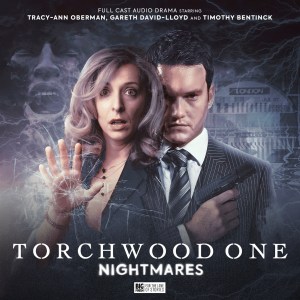
The cover for Torchwood: Nightmares had some additional artwork on the CDs, so did that go through various iterations, or was it always the intention to do bonus artwork?
No, actually – the first one I submitted to James was pretty much the final cover. That was a really interesting one because I didn’t really know the individual stories. It’s tricky with a boxset like that, because you’re summarising. With Nightmares, there are three separate stories with the overarching theme of a ‘nightmare’, so it was much easier to visualise that rather than a mish-mash of three different stories on one cover. Goss said ‘this can be your creative nightmare’, like my concoction, so I went away and experimented, and the other two images that went on the CDs were just other things that I’d tried out. I’d built those images up to about 70% of what they would have been and then thought I wanted to combine Yvonne and Ianto, and that was easier to do with those straight-on shots. So those other pieces were left over and I thought it would be a shame if they just sat on my hard drive forever, so I said to James, ‘I’ve got these, can they go on the CDs?’, and he said yes.
But that cover had the impression… it had a sort of David Lynch thing of looking at something but it’s not quite right. So what I did with those central images was actually take all the colour out of them, made them black and white, and then repainted the skin on a different colour so it deliberately looked kind of strange. It had to be somewhere between uncanny valley and a normal cover, so that was really fun.
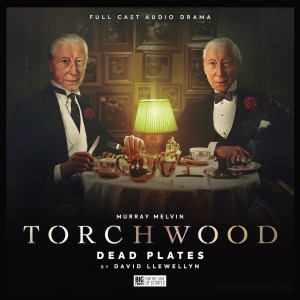
You mentioned on Twitter that Dead Plates went through several iterations – you spoke earlier wanting the covers to look like snapshots from the episodes, and Dead Plates does look like a still, so what was it like creating that one?
When I listened to Dead Plates, I actually realised that I don’t think the cover fully matched the script, but I thought that the vibe worked really well. But that was an interesting cover, because it was a long process – I submitted an original idea, some people liked it, some people didn’t, and we then did a complete 180°, and the final cover was actually finished a very short time before it was announced, which was quite unusual, as normally we’re a fair bit ahead. But it was interesting, because the image of the two guys sat at a table was a really, really old black-and-white stock image that I found, and I wanted to evoke Jack Torrance in The Shining, and I thought that if anyone would be having a creepy dinner with Bilis, it would be Bilis! So it stemmed from that, I colourised the image and built it up from there. And again I wanted that uncanny valley feel, so I flipped the face on one of them so it looked a little weird. I think I could have tinkered with it a lot more, but I was satisfied the final cover and the response was very good, and I liked that some people said that it looked a bit weird.
What has been the most challenging cover for you to work on in terms of wondering whether you could do more work on it?
I find I do that a lot – I’m never satisfied with my own work, I can always carry on. But I always say that the one I’m working on must be better than the last one. Those early ones were challenging, but that’s because I was finding my feet and trying not to copy Lee, doing something original but making sure it still fits in. The Black Knight originally stuck very closer to the brief, and I put Norton in a period spacesuit, but James said although it looks accurate it needed to look more playful, so we did a ‘Tintin’ rocket, and the spacesuit was assembled from various Doctor Who spacesuits. That’s one that I think I could have spent more time on, because it was something I hadn’t really done before; I was creating lots of new assets for it. So that was a very fun challenge. The challenging ones are always the most fun. It’s great as a designer getting it right first time, but the ones that you work really hard on, and keep pushing it, feel so rewarding when it turns out well.
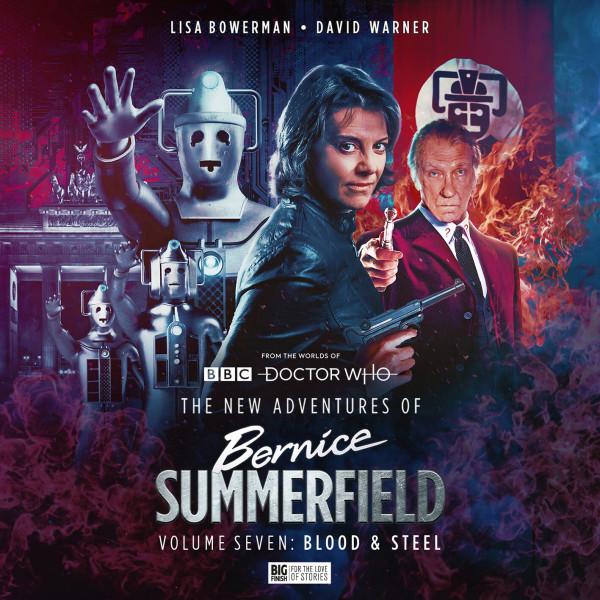
Going to other specific covers, Bernice Summerfield: Blood and Steel has a very strong focus on Benny, and The War Master: Escape from Reality likewise is focussed on the Master, so what’s it like creating a cover where you have to include a lot of detail but maintain focus on one central character?
The Benny cover was an absolute dream. I remember picking up the first boxset of that series when it first came out, and loving it, I think it’s such a strong series, and we’ll miss David so much, he was such a brilliant, brilliant talent and voice. I have to say, the real star of that cover is Chris [Thompson, CGI artist]’s Cybermen. I remember getting the brief from James and it said ‘rows of Cybermen doing Nazi salutes’, and I thought, ‘how on earth am I going to do that?’ There’s so few pictures of the Wheel in Space Cybermen anyway, but I spoke to Chris, he sent them over, and it was perfect. But yes, Benny always had to be star of the show. It was interesting adding in David, because his Doctor has his own alternate universe identity, that we’ve only seen on the front of packaging, so it was a case of going away, making sure the costume matched his others, and making sure it didn’t outshine Benny – she had to be the focus.
I think it’s interesting with that series, because although it’s Doctor Who, the Doctor is almost the companion to Benny rather than the other way round.
It’s a wonderful extension of what’s been done, and it feels very much like those New Adventures that were just Benny, it still matches that vibe, and it was so much fun to play with. And Benny such a brutal history with both the Nazis and the Cybermen, so I felt like she couldn’t just be in a neutral pose, which is where the gun and her fierce expression came from.
What’s it like when you only have a limited selection of photos to use from, and having to manipulate a small selection of stock photos?
I think it’s just my pot luck that I’ve had covers where I’ve needed to put new bodies on people. When I did that first War Master cover I had loads of photos of David Tennant I could use, and then it just got less and less from there. It’s a case of knowing the characters really well. I try not to manipulate faces too much – I think as long as the body is different you can get away with using the same photos of an actor’s face. Like, with Torchwood: War Chest and Suckers, I’d originally accidentally used the same photo of Tosh but I only realised once it was done, so I had to go and change it! But you can also do a lot with colours, setting and lighting.
Does that ever feel limiting?
It’s a challenge that you don’t get bodies in different poses, really. What’s lovely in Torchwood is there’s lots of shots of them crouching, or holding objects in different poses that you don’t really get in headshots. With headshots you have to really match the head to the shoulders, otherwise it looks really weird. That was one that was a particular challenge for Kaleidoscope, and in the end I think that was about ten photos of Jon that I photoshopped together.
I got really lucky with that one, actually – Jon had ridden so many vehicles! The handlebars were the bike from Day of the Daleks, one of the hands was from The Daemons, and another was from the Season 7 photoshoot. Then for the costume I had to find one that a) I hadn’t used on the range before and b) had been used in more than one story so I had more options. So some of it is from The Green Death and a couple from Death to the Daleks. Then the head had to be from Season 11 so the hair matched, so I think I took some aspects from Invasion of the Dinosaurs, and then the goggles were from a stock photo.
But the hardest part was actually Sarah Jane! All the best photos of Sarah Jane were from The Time Warrior, where she had much longer hair. There’s a few from Invasion of the Dinosaurs, but I didn’t want her in a suit as she wouldn’t be wearing one in the snow, so I ended up using some photos from the Season 12 shoot and some from Invasion of the Dinosaurs.
Do you get access through Big Finish to all the photoshoots from Doctor Who and Torchwood or do you have to source the photos yourself?
Big Finish has a bank of photos, but there’s not much Torchwood in there. There’s quite a bit of Doctor Who, but I think that’s an archive that Big Finish have made themselves, as the BBC archives have been through so many iterations that a lot of stuff sadly isn’t there. A few of us designers chat and we share stuff, but I’m always on the hunt for new Torchwood stuff. There’s one photoshoot that I’m on the hunt for, and that’s when they did the BBC/AudioGO shoot. AudioGO is no more, so it’s very tricky to find that one, but I am looking for it. It’s kind of got lost over the years. So we’re assembling stuff ourselves, but Big Finish does have an archive that they help out with as much as they can.
Finally for part 1, if you could design a cover for any franchise that you haven’t already, what would it be?
Honestly, doing Torchwood and Doctor Who is a dream. I remember watching Torchwood when I was eleven, and the sex gas monster came on and I had to watch it covering my eyes and peeking through my fingers! And then I listened to the audios when they first came out, and it’s such a privilege to have taken over from Lee. Lee and Goss gave me such a good foundation, Goss is just the loveliest person, so it’s an absolute joy.
Huge thanks to Sean for speaking to us. His extensive work for Big Finish can be found here: https://www.bigfinish.com/contributors/v/Sean-Longmore-11730.
Keep an eye out for part 2 of this mega-interview, coming soon.
 Who Review
Leave a comment