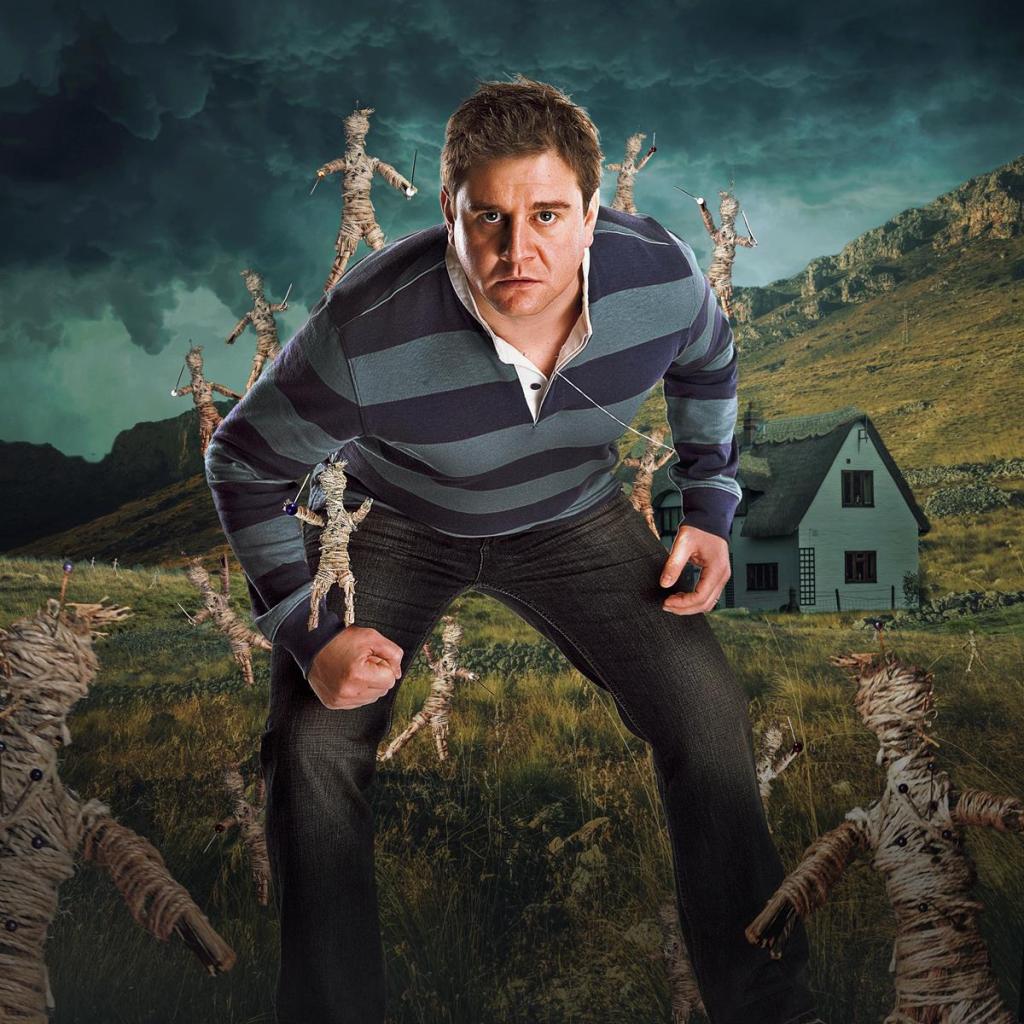
Ahead of the release of 2024’s first Torchwood story, Poppet, Alex Hewitt spoke to writers Lauren Mooney and Stewart Pringle to preview the episode.
Thanks both of you for taking the time to answer some questions! To kick off: a lot of your scripts for the Whoniverse revolve around real-life folklore – what is it about this sort of mythology that you think works so well in a sci-fi environment?
Lauren Mooney: There’s that famous Arthur C. Clarke quote – “any sufficiently advanced technology is indistinguishable from magic”. I think part of what he’s observing is that there’s not such a huge gap between sci-fi and stuff we would think of as magic or fantasy; it’s just about viewpoint. And I guess the kind of folklore we’re drawn to is often a way of extending or explaining things we can recognise, things that touch the edges of our own lives – death, ageing, time – just given a slight kick into the mystical, the inexplicable, the strange. The further you drag those things from the recognisable and the familiar, the more interesting it gets.
Stewart Pringle: I think we’ve also always felt that not everything we introduce has to be totally explained. There’s always been a bit of a tendency in the Whoniverse to give everything a little moment where we say, “this might have looked like a fairy but don’t worry it’s actually a psionic energy beast”, which comes from those sci-fi roots, but it’s fun to push at the boundaries of that a bit. It’s been a real thrill to watch RTD and the mothership pitch a little bit closer to the fantastical in the recent specials, and particularly The Church on Ruby Road – would it actually have made those goblins feel any realer if we’d found out they came from the Planet Jareth and landed in a Cornish tin mine on a comet? I’m not totally sure it would.
I don’t have much interest in high fantasy, or in high sci-fi either really. What I’ve always loved is the boundary-lines between history and myth, between our world and another, impossible one. I’m just as happy if that invisible world flies crashing into ours on a broom as aboard a spaceship. And that feels more possible than ever at the moment – big thanks to the Fourteenth Doctor for spilling all that salt at the dark fringes of the universe…
Why did you choose Rhys for this story and how did you find your first time writing for him?
SP: We’d wanted to write for Rhys for a while, and had been brewing up a story set in an old folks’ home against some kind of alien euthanasia entity we were calling ‘The Knacker’, which was sort of about the way we treat the elderly and particularly how this country treated them during COVID. But then Lizzie Hopley‘s Sonny came out last year and it was just so fantastic, and so absolutely said everything that we wanted to say and did it with such charm that we had to park our idea. But we kept a torch burning for Rhys. He’s the centre of Meat, for my money one of the most impressive episodes of the original Torchwood run, and that outsider/insider perspective is just super interesting. And the way he is left at the end of Children of Earth, a father, on the run, cursed with knowledge that he never asked for and that places everyone he loves in the gravest danger. What a guy!
Did placing Poppet at that particular point in his life help inform his characterisation here?
LM: This story picks up in an imagined space post-Children of Earth, where he’s without Gwen and Anwen for a few weeks, because for various reasons its safest for them to travel separately for a little while. He’s in a waiting place, in a small Welsh town, hiding out – just trying to keep ticking over and keep his head down. But it’s a strange time for him, separated from the family he loves and that so define his identity – which makes him particularly vulnerable to the events of this story…
Your previous story, Dog Hop, was based on a real-life pub – were there any similar inspirations for Poppet?
LM: Nothing in our real lives, thankfully!! The folklore was the starting point – James Goss (who runs the Torchwood range, and script edited this story) wanted something about poppets – human effigies used in magic, either to protect or curse, depending on your mileage. I’d been to an exhibition at the Ashmolean a few years earlier, Spellbound, which had a room poppets people had dug out of their chimneys, and we liked the thought of people living in a house that had these charms in the walls without knowing it. Then we got talking about a story I’d been obsessed with as a kid, and only half-remembered.
I was quite a gothic child, and in the mid-90s became a rabid collector of Spinechillers magazine, the most amazing mix of urban legends and short stories. There was one I dimly remembered about a family moving into a cursed house, and beginning to experience very strange things. We talked about that, and poppets in the walls, and soon an idea began to form…
SP: We’ve also been really interested in apotropaic markings for ages, ritual protection marks on old houses, all of these little fingerprints of occult belied scattered around the old houses of England. Such an ancient, haunted country, this – so stuffed with overlapping, contradicting, half-fanciful, half-deadly serious beliefs and ideas, no wonder weird shit comes bleeding through.
What were your highlights when writing this episode?
SP: It’s hard to talk about without giving spoilers, but pretty much from the start I knew I wanted to include a particular set-piece, a game which I’d played every Halloween with my Grandma as a kid. It was my absolute favourite game, to the extent that I’m pretty sure I made my family play a version of it at Christmas too. And then when I was a young teenager I found an amazing story in an issue of the 1950s EC comic SHOCK SuspenStories, where they play the game and it goes horrifically wrong in this perfectly gruesome but ambiguous way. Later on I found out that strip was itself based on Ray Bradbury’s short story The October Game, and I’m an absolute Bradbury nut, so the whole Samhain scene became a kind of tribute to him, and to my Grandma.
But the whole story is pure Bradbury really, filtered through Stephen King, and through Loz’s Spinechillers magazine, and God knows what else. There is a line of uncanny, creepy, cosy writing that relies on the unexpected arrival of unexplained evil within a domestic setting, a line which runs from M R James through so much of the supernatural writing of the 20th century. Poppet feels like a(nother) tribute to that. Also, so many of the things that end up in these stories come from unrealised ideas we’ve had for theatre/telly projects at one stage or another – the number stations in Lincolnshire Poacher, the whole of Dog Hop, the idea of a modern take on The Signalman in Below There – the sort of inciting incident for this story, the mother who has lost her child, then gone on to lose even more of them, was the start of a script I tried to write a decade ago. I find it such a terrifying premise.
LM: I will actually also say that this one was quite a hard write. Usually, we have an idea for a story, run it past our editor, and then draw up a treatment, which lays out every beat in the episode and has to be seen and approved by lots of people. It’s a hard process, but it means that when we come to write the script, it’s just a case of following the things we’ve already agreed, scene by scene by scene – which is really useful if you co-write stories, as Stew and I do. We tend to do that by writing about 1500 words each and editing each other’s work, rather than by sitting and holding the pen together. Hopefully through that process it gets any funny edges knocked off, and comes to feel like something cogent, as if it had only one writer.
But with this, the team were so keen on the idea and so confident in it that we got waved through without a treatment, and hit the ground running pretty quickly. “Great!” we thought. “We’ve saved loads of time!” Reader, we had not. Trying to get the middle to work was absolute HELL. We ended up getting fewer notes from James and doing fewer redrafts than we usually would, so he’d probably say this was our smoothest process – but that’s because we did all the agonising in private, in the middle of draft one. Boy did we learn our lesson. We will NEVER skip out on writing a treatment ever, ever, ever again!
Finally, can you give any teases for the story, or things for listeners to look out for?
LM: No comment, sorry. Actually, one comment – we’re not allowed to use brand names in any Big Finish, but there’s a nice little cameo from what’s clearly supposed to be a Tunnock’s Snowball, so please do enjoy that.
SP: Yes, this really feels like one where the less you know going in, the better. We wanted to write a story where you can’t trust anything, or anyone. To put the listeners into Rhys’s shoes. You’re all alone. The night is dark. The storm is wild. The witch is dead.
Many thanks to Lauren and Stewart. Torchwood: Poppet is available to pre-order now from bigfinish.com ahead of its release on Thursday 18th January.
N.B. This interview has been lightly edited for clarity.


 Who Review
Leave a comment